3D Printing for Robotics in Dubai | Custom Parts & Rapid Prototyping
3D printing lets robotics teams turn CAD files directly into functional parts – brackets, housings, end effectors, and prototypes with no tooling and much faster iteration than traditional machining.
At Robust3D, we help robotics startups, automation companies and engineering teams across Dubai build and test these parts, from single prototypes to low-volume production, while also handling reverse engineering for legacy parts and finishing for outdoor or brand-matched components.
Why Robotics Teams Choose 3D Printing
Robotics development moves fast, and traditional manufacturing methods often can’t keep pace.
For robotics teams specifically, this means faster iteration between design and physical testing, lighter components that improve speed and energy efficiency, and the ability to produce low-volume batches economically instead of committing to large production runs before a design is proven. It also means design changes are cheap: a revised bracket or housing is a new print file, not a new tool, so a late-stage design change doesn’t carry the cost penalty it would with molded or machined parts.
Injection molding requires expensive tooling that only makes sense at high volumes.
CNC machining is precise but struggles with the complex internal geometries robotic housings and end effectors often need.
3D printing solves both problems: no tooling costs, and geometric freedom that lets engineers design for function first, not manufacturability constraints.
Robotic Components We Manufacture
We produce a wide range of functional robotic parts across FDM, SLA, and SLS printing, engineered to fit, move, and perform as designed – not just look the part.
Our 3D Engineering team supports design refinement before printing, so parts are optimized for both function and manufacturability from the first iteration.
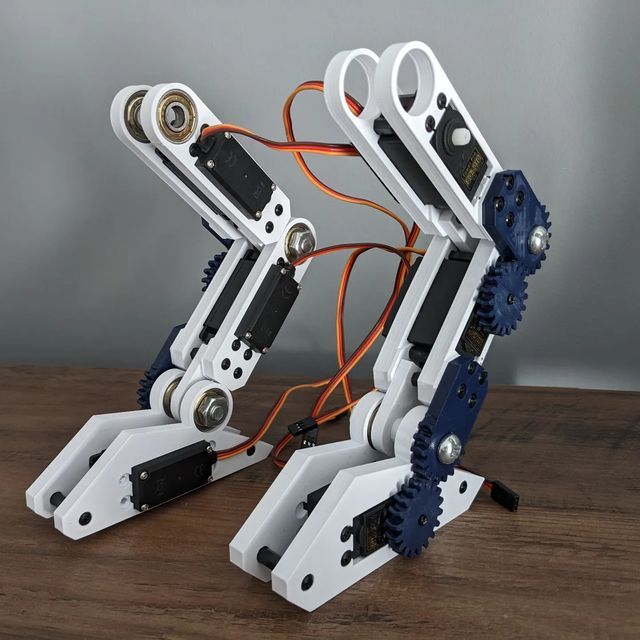
Robotic Arm & Motion System Components
Links, joints, gear housings and mounting brackets for robotic arms and motion systems, printed with the dimensional accuracy needed for moving assemblies and repeated mechanical stress. We account for wear surfaces and fit tolerances at the design stage, not just at final inspection.
End Effectors & Grippers
Custom grippers, tooling attachments and end-of-arm components designed around your specific payload, material and grip requirements – iterated quickly as your application evolves. Because reprinting a revised gripper costs a fraction of retooling one, this is often where 3D printing delivers the fastest development gains.
Sensor Housings & Enclosures
Protective housings for sensors, cameras and electronics, designed to the exact internal clearances and mounting points your components need, with cable routing and access points built in from the start. We can also apply protective coatings for housings exposed to dust, moisture or UV.
Brackets, Mounts & Structural Parts
Lightweight structural components and mounting brackets that reduce overall robot weight without sacrificing strength – a direct contributor to speed, agility and battery life in mobile and autonomous systems. Internal lattice structures and material selection are used to cut weight where load-bearing strength allows it.
Design Considerations for 3D Printed Robotic Parts
Not every design translates directly from a molded or machined part to a printed one, and getting this stage right avoids wasted iterations later.
Our engineering team reviews these factors during the consultation stage, before the first prototype is printed, so early design decisions don’t have to be re-learned through failed parts.
-
Wall thickness
Wall thickness needs to suit the chosen material and process – too thin and a part flexes or fails under load, too thick and print time and material cost rise without adding real strength.
-
Clearance tolerances
Moving assemblies need clearance tolerances built in from the start, since printed parts can fit tighter than machined ones if clearances aren’t accounted for.
-
Load paths & print orientation
Load paths matter too: orienting a part so stress runs along the strongest print direction, rather than across weaker layer lines, is often the difference between a bracket that survives testing and one that doesn’t.
-
Overhangs & unsupported spans
Overhangs and unsupported spans also behave differently across FDM, SLA and SLS, so a design that prints cleanly in one process may need rework in another.
Our Robotics Development Process
We follow a consistent, engineering-led process on every robotics project, whether it’s a single prototype or a production batch.
-
01
Consultation & Requirements Review
We review your application, load requirements and design files to confirm the right printing technology and material for the part’s role in the system.
-
02
Design Support & CAD Refinement
Our engineering team can refine your CAD for printability and mechanical performance, or work directly from your existing files if they’re already print-ready.
-
03
Prototype Printing
The first iteration is printed and prepared for functional testing, so you’re validating a real, physical part rather than a render or simulation.
-
04
Functional Testing & Feedback
You test fit, function and performance under real conditions, and share feedback for the next revision.
-
05
Design Iteration
We reprint updated versions quickly, so multiple design cycles can happen in the time one round of tooling-based manufacturing would take.
-
06
Low-Volume Production & Finishing
Once the design is validated, we move into low-volume production, with paint, coating or surface finishing available where the application calls for it.
Materials & Technologies for Robotics Parts
Material and technology choice depends on the part’s role in the system – a structural bracket has different requirements than a sensor housing or a high-precision gear, and choosing the wrong one usually shows up as a failed test rather than a failed print. Here’s how we match technology to application:
| Technology | Best for | Typical use in robotics |
|---|---|---|
| FDMFused Deposition Modeling | Durable functional parts, larger components | Brackets, housings, structural frames |
| SLAStereolithography | High-precision, fine-detail parts | Small gears, connectors, precision fittings |
| SLSSelective Laser Sintering | Complex geometries, no support structures needed | Enclosures, ducting, intricate internal features |
For parts that need to go beyond as-printed performance, we also offer paint and protective coating services – useful for robotics deployed outdoors or in environments with UV, moisture or chemical exposure.
And where a robot needs a mix of part types across a single build – some structural, some precision, some complex-geometry – we can combine technologies across one project so each component is produced the right way rather than forcing every part through a single process.
Who We Work With
Our robotics work spans a few consistent groups.
Robotics startups & innovators
Robotics startups and innovators come to us for fast, low-cost iteration before committing to tooling or large production runs, often needing several design cycles in the space of a few weeks.
Industrial automation companies
Industrial automation companies work with us on fixtures, jigs and end-of-arm tooling for existing production lines, where a custom-fit part beats a generic off-the-shelf option.
Engineering & R&D teams
Engineering and R&D teams at universities and manufacturing companies typically need functional prototypes for testing rather than display models, and value the ability to iterate quickly between test cycles.
If your robotics application overlaps with automotive or manufacturing, our engineering team also draws on direct experience finishing and producing parts for those sectors, which often share similar tolerance and durability requirements with robotics components.
Quality, Tolerances & Transparent Pricing
Checked against your specification
Robotic components live or die on fit – a bracket that’s a fraction of a millimeter off can bind a moving assembly, and a housing that doesn’t clear its mounting points is unusable regardless of how good the print quality looks.
We hold the same tight-tolerance standards on robotics parts that we apply across our engineering work, and every part is checked against your specification before it’s handed over, not just visually inspected.
Quoted in AED, stage by stage
We also quote every robotics project in AED with a clear breakdown of process and timeline, so there are no surprises between your initial consultation and delivery – useful when you’re running multiple design iterations and need predictable costs at each stage.
Frequently Asked Questions
How is 3D printing used in robotics?
3D printing produces robotic components directly from CAD files – brackets, housings, end effectors, gears and structural parts – without the tooling costs or lead times of injection molding or machining, making it well suited to prototyping and low-volume production runs.
Which materials are best for robotic components?
It depends on the part. FDM thermoplastics suit durable structural parts and housings, SLA resins suit small, high-precision components like gears and fittings, and SLS is well suited to complex geometries such as enclosures and internal ducting that would be difficult to produce any other way.
Can 3D printed robotic parts be used for functional applications, not just prototypes?
Yes. With the right material and design, 3D printed parts can be used in functional, load-bearing robotic assemblies, not only display or presentation models. We engineer each part to the tolerances and stresses its specific application requires.
Do you manufacture custom robotics parts in Dubai?
Yes. We design, print and finish custom robotic components in-house at our Dubai facility, from single prototypes through low-volume production runs, with every project quoted in AED.
What industries benefit from robotics prototyping with 3D printing?
Industrial automation, manufacturing, logistics and R&D teams all benefit – anywhere robotic systems need fast design iteration, lightweight components, or low-volume custom parts that don’t justify traditional tooling costs.
How quickly can robotics prototypes be delivered?
Turnaround depends on part size, material and complexity. Share your CAD files and application details and we’ll confirm a timeline and AED quote before work begins.
Can you help refine a robotics design that isn’t print-ready yet?
Yes. Our engineering team reviews wall thickness, tolerances and load paths as part of the consultation stage, and can refine your CAD for printability before the first prototype is produced – this catches most design issues before they become a failed print.
Let’s Build Something Amazing Together!
Whether you’re prototyping a new robotic gripper or moving a proven design into low-volume production, our engineering team will help you choose the right material, refine your design for printability, and get your parts moving faster than traditional manufacturing allows. Reach out with your CAD files and application details to get started.
Call +971 50 221 8492 or email info@robust3d.com