3D printing has made product development faster and more accessible than ever before. Businesses can move from a digital design to a physical prototype in a matter of days, making it easier to test ideas, refine products, and reduce development time. However, the quality of the final printed part depends largely on the quality of the digital model that is sent for printing.
Many businesses assume that once a CAD model is complete, it is ready for production. In reality, even a well-designed model can contain issues that affect print quality, increase production costs, or delay delivery. Simple mistakes such as incorrect wall thickness, unsuitable materials, missing tolerances, or poor file preparation can lead to failed prints or prototypes that do not perform as expected.
Preparing a model correctly before sending it for 3D printing helps avoid unnecessary revisions and ensures the finished part meets both functional and visual requirements.
In this guide, we look at the most common mistakes businesses make before submitting a model for 3D printing and explain how careful planning can lead to better results.
Why Proper File Preparation Matters
A successful 3D printing project begins long before the printer starts working. The digital model acts as the blueprint for the entire manufacturing process, and any issue within the design will usually appear in the final printed part.
Taking time to review the model before submission helps identify design problems, improve print quality, reduce material waste, and shorten production time. It also allows the printing team to recommend improvements that may increase strength, reduce costs, or simplify manufacturing.
Businesses that invest in proper file preparation often complete projects faster because there are fewer revisions and fewer unexpected production issues.
Mistake 1: Designing Without Considering the Printing Process
One of the most common mistakes is designing a product without considering how it will be manufactured.
A model that looks perfect on a computer screen may be difficult or impossible to print efficiently.
Different 3D printing technologies have different capabilities, build volumes, layer resolutions, and material limitations. Features such as unsupported overhangs, extremely fine details, or enclosed cavities may require design modifications before printing.
Designing with the chosen manufacturing method in mind helps reduce production challenges and improves the overall quality of the finished part.
Mistake 2: Incorrect Wall Thickness
Wall thickness is one of the most important factors affecting print quality and part strength.
Walls that are too thin may become fragile, deform during printing, or fail. On the other hand, unnecessarily thick walls increase material usage, printing time, and production costs.
The ideal wall thickness depends on the selected material, printing technology, and intended application.
For example, a concept model may require different design considerations than a functional engineering component that will experience mechanical loads.
Professional design reviews help ensure that wall thickness is appropriate for both printing and long-term performance.
Mistake 3: Ignoring Material Selection
Not every material performs the same way.
Some businesses choose materials based only on appearance or cost without considering the actual working conditions of the finished part.
Factors such as strength, flexibility, heat resistance, chemical exposure, impact resistance, and surface finish should all influence material selection.
A prototype intended for visual presentation may work well with standard plastics, while functional testing may require engineering-grade materials capable of withstanding repeated use.
Selecting the right material early helps prevent performance issues and unnecessary redesigns later in the project.
Mistake 4: Sending Incomplete or Incorrect Files
Another common issue is submitting files that are incomplete or unsuitable for manufacturing.
Missing surfaces, open geometries, duplicate elements, or damaged file structures can prevent successful printing.
Businesses should ensure that files are exported in the correct format and checked for common modeling errors before submission.
Providing supporting information such as dimensions, intended application, assembly requirements, and material preferences also helps the printing team prepare the project more efficiently.
Good communication at the beginning of the project often prevents delays later.
Mistake 5: Overlooking Tolerances and Assembly Requirements
Many printed parts are designed to fit with other components.
Ignoring manufacturing tolerances during the design stage may result in parts that are either too tight or too loose during assembly.
Clearances should be considered whenever products include moving parts, fastening systems, snap-fit connections, or mechanical assemblies.
Engineers often adjust dimensions slightly to account for the printing process and ensure proper fit after production.
Reviewing assembly requirements before printing reduces the need for post-production modifications.
Mistake 6: Expecting the First Prototype to Be the Final Product
A prototype is designed to support learning and improvement.
Some businesses expect the first printed model to be production-ready without allowing time for testing or design refinement.
In reality, product development usually involves several prototype iterations.
Each version provides valuable information about functionality, ergonomics, strength, appearance, and manufacturability.
Treating prototyping as an opportunity to improve the design often results in a better final product while reducing long-term manufacturing risks.
Mistake 7: Ignoring Post-Processing Requirements
Many businesses focus only on the printing stage and overlook what happens afterwards.
Depending on the application, printed parts may require sanding, painting, polishing, machining, assembly, or protective coatings.
Presentation models often need a smooth surface finish, while engineering components may require additional machining for critical dimensions.
Discussing finishing requirements before printing allows engineers to prepare the model accordingly and recommend the most suitable manufacturing approach.
Planning for post-processing also helps produce a more accurate project timeline.
Mistake 8: Not Reviewing the Model Before Submission
Even experienced design teams can overlook small errors.
Before sending a file for printing, it is good practice to carry out a final design review.
Check dimensions, verify scale, confirm material selection, inspect assemblies, and ensure all design features are intentional.
Reviewing the model with engineers or manufacturing specialists often identifies opportunities to improve printability or reduce production costs.
A short design review can prevent several days of unnecessary revisions.
Mistake 9: Focusing Only on Cost Instead of Performance
Choosing the lowest-cost printing option is not always the most economical decision.
A cheaper material or printing method may not provide the strength, accuracy, or surface finish required for the application.
If a part fails during testing or requires multiple reprints, the overall project cost increases significantly.
Selecting the right technology based on the product’s intended purpose usually delivers better long-term value than simply choosing the lowest initial price.
Experienced engineering teams help businesses balance performance, quality, and budget without compromising the success of the project.
Mistake 10: Working Without Engineering Support
Some businesses prepare models independently without consulting experienced engineering professionals.
While modern CAD software is powerful, successful product development involves more than creating a digital model.
Engineers consider structural performance, manufacturing limitations, assembly methods, material behaviour, and long-term product reliability throughout the design process.
Professional guidance often identifies issues that may not be obvious during design but could become expensive problems during manufacturing.
Working with an engineering partner from the beginning reduces risks while improving overall project quality.
Best Practices Before Sending a Model for Printing
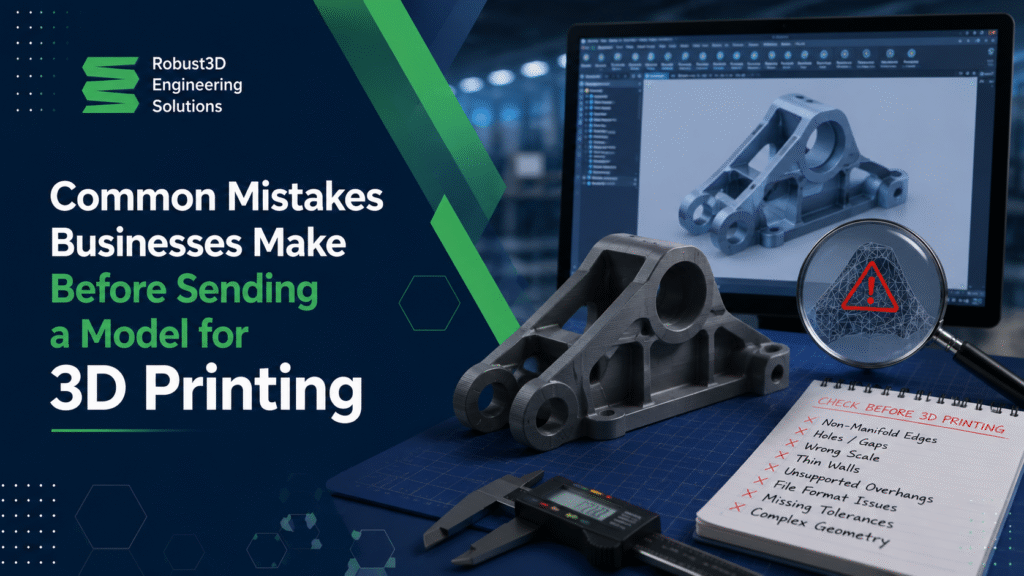
A few simple checks can greatly improve the chances of a successful print.
Ensure that the model has the correct dimensions and scale before exporting the file.
Confirm that the selected material matches the product’s intended application.
Review wall thickness, clearances, and assembly features.
Verify that the file is complete and free from geometry errors.
Consider whether any post-processing will be required after printing.
Finally, discuss the project with your 3D printing provider. Sharing information about how the part will be used helps engineers recommend the most suitable printing technology, material, and finishing process.
These small steps often prevent delays, reduce costs, and produce better quality results.
Why Businesses Choose Robust3D for Professional 3D Printing
Successful 3D printing starts with good engineering decisions. At Robust3D, every project is reviewed carefully before production begins to ensure the design is suitable for manufacturing and performs as intended.
The team provides support with CAD design, design optimisation, rapid prototyping, reverse engineering, 3D scanning, material selection, and industrial 3D printing. By evaluating each project from both an engineering and manufacturing perspective, potential issues can be identified before they affect production.
This collaborative approach helps businesses reduce development time, minimise revisions, and produce high-quality prototypes and functional components with greater confidence.
Conclusion
A well-prepared digital model is the foundation of every successful 3D printing project. While modern printing technology can produce highly accurate parts, the final result depends on thoughtful design, correct material selection, proper file preparation, and careful engineering review.
Avoiding common mistakes such as incorrect wall thickness, poor material choices, missing tolerances, or incomplete files helps improve print quality while reducing unnecessary costs and delays.
Businesses that work closely with experienced engineering and 3D printing specialists are better equipped to develop reliable products, shorten development timelines, and move into production with confidence.
Whether you are creating your first prototype or preparing a product for manufacturing, taking the time to prepare your model correctly can make a significant difference to the success of your project.
Continue exploring