If you’ve ever paid for a mould, a die, or a tooling setup only to find out the design needed one more change, you already know where most manufacturing budgets go. It’s rarely the raw material. It’s the tooling, the rework, and the weeks lost waiting for the next iteration. 3D design services cut manufacturing costs by removing tooling investment for low volumes, catching design flaws digitally before they reach production, reducing material waste through smarter part geometry, and compressing development timelines from months to days. The savings aren’t theoretical. They show up on the very first prototype run.
This matters more in Dubai and the wider UAE than almost anywhere else right now. Under the Dubai 3D Printing Strategy, the emirate is pushing additive manufacturing into construction, healthcare, and industrial production at a pace few other markets are matching, and the Middle East’s 3D printing market as a whole is expanding fast enough that more manufacturers, product developers, and startups are weighing 3D design and printing against traditional tooled production for the first time. Here’s exactly where the cost savings come from, how big they actually are, and where 3D design still isn’t the right call.
What Do 3D Design Services Actually Include?
Before the cost breakdown makes sense, it helps to know what’s inside a proper 3d design service, because this is where a lot of confusion (and wasted money) starts.
A complete 3D design service typically covers CAD modelling, Design for Additive Manufacturing (DfAM), mechanical design optimisation using FEA tools, and production-ready CAD development. It is not the same as 3D rendering or visualisation, which produces images for marketing rather than manufacturable files. The distinction matters: a beautifully rendered concept that hasn’t been engineered for manufacturing will cost you money later, not save it.
Good 3D design work happens before a single part gets printed. That’s the part most people skip, and it’s the part that carries the biggest cost impact. It’s also the part that separates a design and engineering partner from a print shop. Plenty of providers in Dubai will happily print whatever CAD file you send them. Fewer will tell you the file is going to waste material, print time, or strength before it ever reaches the machine.
The Real Cost Drivers in Traditional Manufacturing
Traditional manufacturing costs stack up long before a product reaches the market. Tooling, design revisions, wasted material, and slow iteration cycles all add up quietly, often doubling or tripling a project’s real cost compared to the original quote.
| Cost Driver | Traditional Manufacturing | 3D Design-Led Manufacturing |
| Tooling and moulds | AED 15,000–150,000+ upfront, per design | Not required for prototyping or low volumes |
| Design changes | New tooling or rework needed each time | Edit the CAD file, reprint in hours |
| Material waste | Up to 90% removed in subtractive machining | Only the material the part actually needs |
| Lead time to first part | Weeks to months | 24–48 hours for simple prototypes |
| Minimum order quantity | Often required to justify tooling cost | None; order 1 unit or 500 |
| Design validation | Physical trial and error | Simulated (FEA/CAD) before manufacturing |
Every row in that table represents money that either gets spent or gets avoided, depending entirely on when the design work happens in your process.
1. Tooling Costs Disappear for Prototypes and Low Volumes
This is the single biggest saving, and it’s the one most businesses feel first. Injection moulding and die casting both require expensive, custom-built tooling before you produce a single usable part. That tooling has to be designed, machined, and tested, and none of that cost changes whether you need 10 units or 10,000.
3D design and additive manufacturing remove that step entirely. A CAD file goes straight to the printer. There’s no mould to commission, no minimum order quantity to hit just to make the tooling investment worthwhile, and no six-figure sunk cost if the design needs a revision. For businesses producing anywhere from 1 to roughly 500 units, this alone usually makes 3D-printed production cheaper than tooled manufacturing on a per-project basis.
2. Design Flaws Get Caught Before They Get Expensive
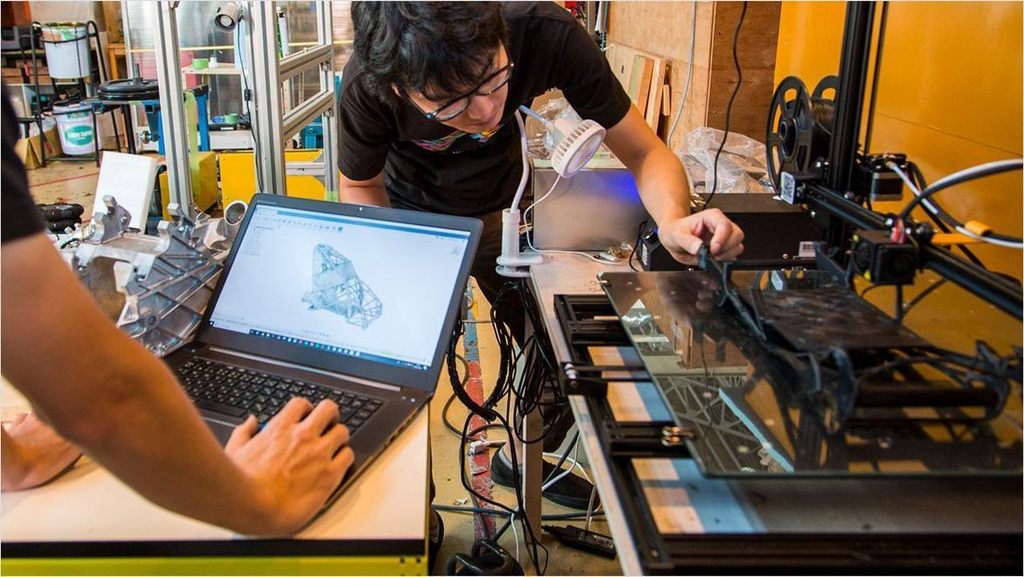
In traditional manufacturing, a design flaw discovered after tooling is cut is one of the costliest mistakes a project can make. The mould has to be reworked or scrapped, and the schedule slips by weeks. 3D design services catch these problems earlier, using structural analysis (FEA) to test how a part will behave under load, heat, or stress before it’s ever manufactured, and rapid CAD-to-print iteration to run through several design versions in the time traditional manufacturing would take to produce one. Every flaw found on screen or in an early prototype is a flaw that never becomes a tooling bill.
3. Smarter Geometry Means Less Wasted Material
Subtractive manufacturing, machining a part from a solid block, throws away a large share of the raw material as scrap. Depending on the part, that waste can run as high as 90%.
Additive manufacturing builds a part layer by layer, using material only where the design actually needs it. This is where Design for Additive Manufacturing (DfAM) earns its keep. A design engineer working in DfAM can introduce internal lattices, hollow sections, and topology-optimised shapes that would be impossible to machine but are straightforward to print, cutting material use and print time while often improving strength-to-weight performance. Less material bought, less material wasted, less material to dispose of.
4. Fewer Parts Means Lower Assembly and Inventory Costs
One of the most underrated ways 3D design reduces cost is part consolidation. When multiple components that would normally be manufactured, stocked, and assembled separately get redesigned as a single printed piece, the savings extend well beyond the print itself: less assembly labour, fewer fasteners and connectors, fewer points of potential failure, and less inventory to warehouse and track. Aerospace and automotive manufacturers have used this approach to cut both part count and total assembly cost significantly on complex components, and the same principle applies at a smaller scale to jigs, fixtures, brackets, and housings.
5. Development Timelines Shrink From Months to Days
Time is a cost, even when it doesn’t show up as a line item. Every week a product spends in development is a week of engineering salaries, delayed revenue, and lost competitive advantage. Traditional prototyping, sourcing tooling, running trial batches, adjusting, and running them again can take weeks per iteration. A 3D design and printing workflow compresses that same loop into a single working day in many cases: submit a CAD file today, hold a functional prototype tomorrow, test it, adjust the file, and print again. That speed doesn’t just save money on the current project. It gets your product to market before competitors are still waiting on their second mould revision.
6. Low-Volume and Custom Production Finally Makes Financial Sense
Traditional manufacturing punishes small orders. Tooling costs get spread across units, so short runs carry a brutal per-unit price, which is exactly why so many good product ideas never get past a 50-unit market test. 3D design paired with additive manufacturing removes that penalty. Batches of 5 to 500 units become commercially viable because there’s no tooling cost to amortise, opening the door to market testing without major capital risk, spare parts production without warehousing years of stock, and genuinely custom or personalised products at a price traditional manufacturing simply cannot match.
How Much Can You Actually Save?
The savings vary by part and volume, but the pattern holds consistently across industries: the earlier good design work enters the process, the more it saves downstream.
| Where the Saving Comes From | Typical Impact |
| Design optimisation before printing | 20–40% reduction in part cost |
| Eliminating tooling for low-volume runs | Full tooling cost avoided (often AED 15,000+) |
| Part consolidation | Fewer components, lower assembly labour |
| Reduced material waste | Material used drops close to what the part actually requires |
| Faster iteration | Days instead of weeks per design cycle |
These figures come from design optimisation and industry data on additive manufacturing outcomes rather than any single vendor’s marketing claims, and they hold up reasonably well whether the end use is an automotive bracket, a robotics housing, or a retail display fixture.
Why the UAE Is a Particularly Strong Case for Design-Led Manufacturing
Dubai isn’t just adopting additive manufacturing as a novelty. The Dubai 3D Printing Strategy set a public target for a significant share of new buildings to use the technology by 2030, and that same government-backed push has pulled investment and expertise into industrial and product-focused 3D printing alongside construction. The Middle East’s 3D printing market has been growing at a double-digit annual rate for several years, and manufacturers on the ground are already citing real numbers: local automotive part production using additive manufacturing has reportedly cut import costs by up to 40% for some UAE-based operations, simply by removing the shipping, customs, and lead time of sourcing parts from overseas.
For businesses based in Dubai or the wider Emirates, that’s a practical advantage most competitors elsewhere don’t have. A design and manufacturing partner based locally means shorter logistics chains, faster turnaround on iterations, and no import delays on time-sensitive prototypes, on top of the tooling and material savings that apply everywhere additive manufacturing is used.
When 3D Design Services Won’t Save You Money
It’s worth being straightforward here, because overselling this would do more harm than good. 3D design and printing is not always the cheaper option, and a good design partner should tell you that upfront.
For genuinely high-volume production, tens of thousands of identical units, traditional injection moulding still wins on per-unit cost once tooling is amortised. Certain materials and finishes, particularly some metals and specific surface requirements, remain more economical through conventional casting or machining at scale. And a rushed design process, even a 3D-printed one, can still produce a part that fails testing and needs rework. The cost benefit comes from doing the design work properly, not from the technology alone.
The honest advice: use 3D design and additive manufacturing for prototyping, low-to-medium volume production, complex geometries, and fast iteration. Reassess the maths once you’re planning production runs in the tens of thousands.
How Robust 3D Approaches Cost-Efficient Design
At Robust 3D Engineering Solutions in Dubai, cost reduction starts at the CAD stage, not the print stage. Our design and engineering team works in SolidWorks and Creo to produce production-ready models, applies DfAM principles to reduce material and print time before a file ever reaches a printer, and runs mechanical design optimisation using FEA tools like ANSYS and HyperWorks to catch structural issues early.
We work across FDM, SLA, and SLS technologies, which means the material and process get matched to your part’s actual requirements rather than whatever a single machine happens to produce. And because design and manufacturing sit under one roof at our Al Qusais facility, there’s no handoff gap between the engineer who designs the part and the team that prints it, which is often where cost and time get lost at other providers.
If you’re weighing a prototype run, a low-volume production batch, or a part redesign to cut cost on an existing component, sharing your CAD file or design brief with our team gets you an accurate quote, not a vague estimate.
Frequently Asked Questions
Does 3D design always cost less than traditional manufacturing?
No. It’s typically more cost-effective for prototyping, low-to-medium volume production (roughly 1 to 500 units), and complex geometries. For very high-volume runs of tens of thousands of identical simple parts, traditional tooled manufacturing can still work out cheaper per unit.
How quickly can a 3D-designed prototype be produced in Dubai?
Simple FDM concept models can often be produced within 24 to 48 hours. More complex assemblies, large-format prints, or parts needing detailed finishing take longer, depending on the design and technology involved.
What is DfAM and why does it affect cost?
Design for Additive Manufacturing (DfAM) is the practice of designing a part specifically to take advantage of 3D printing, using lattices, hollow sections, and optimised geometry that reduce material use and print time while maintaining strength. Skipping DfAM and simply printing a design meant for machining usually wastes both material and money.
Can 3D design services help with an existing part that’s too expensive to manufacture?
Yes. Mechanical design optimisation and reverse engineering can take an existing component, analyse where it’s overbuilt or inefficient, and redesign it to be lighter, stronger, or cheaper to produce, often without changing its function or fit.
Do I need a finished CAD file to start, or can a design team create one from scratch?
Either works. Some clients arrive with a complete CAD file ready for review; others start with a sketch, a reference product, or just an idea, and the design team builds the CAD model from that starting point through to a production-ready file.
Is 3D printing wasteful compared to traditional manufacturing?
Generally, no, the opposite. Additive manufacturing builds parts by adding material only where needed, while subtractive machining can waste up to 90% of the starting material as scrap. For most part geometries, 3D printing is the lower-waste option.
How much does 3D design and printing typically cost in Dubai?
Pricing depends heavily on part complexity, material, and volume, but as a general guide, basic concept models in PLA or PETG typically start from AED 25–80, functional engineering prototypes in Nylon or ABS range from roughly AED 75–350, and high-detail SLA resin prints for precision applications start from around AED 90. Design work, when needed from scratch, is usually quoted separately based on complexity. Sharing your CAD file or a design brief is the fastest way to get an accurate number rather than relying on general ranges.