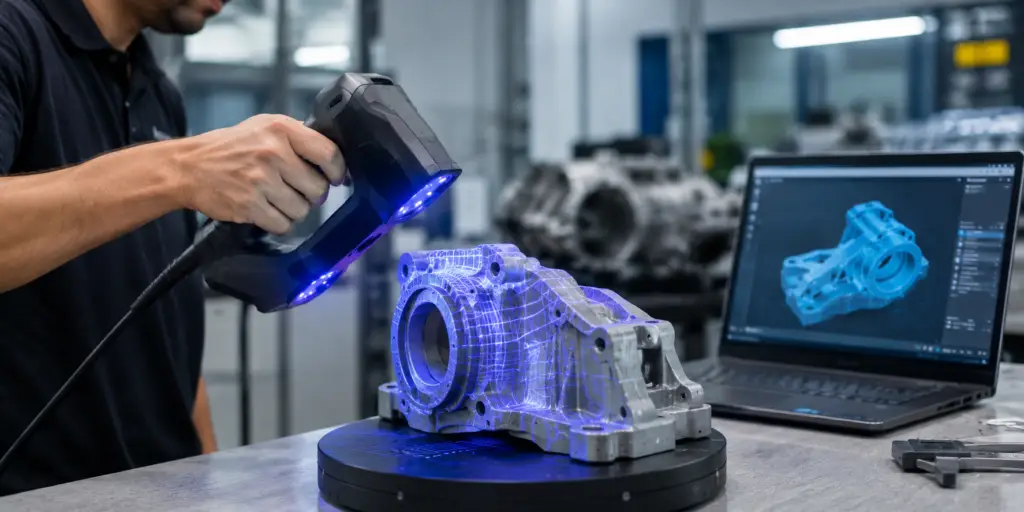
3D scanning captures the exact shape, size, and surface detail of a real object and turns it into a digital 3D model you can measure, edit, or manufacture from. It works by projecting light or lasers onto an object and recording how that light reflects back, then converting millions of data points into a usable CAD file. Businesses across Dubai and the UAE use it for reverse engineering discontinued parts, checking manufactured components against their original design, and speeding up prototyping across automotive, architecture, and industrial manufacturing.
If that sounds abstract, it’s because most explanations of 3D scanning stay at the technical level and stop there. This guide covers what the technology actually does, which method fits which job, what it costs in the UAE, and how to tell a good scanning partner from one that will hand you a mesh full of holes.
What Is 3D Scanning, Exactly?
3D scanning is a non-destructive way to digitise the geometry of a physical object without touching or altering it. The scanner captures the object’s surface as a “point cloud,” a collection of millions of coordinates in space that together describe its shape. That point cloud then gets processed into a mesh or a fully modelled CAD file, depending on what you need it for.
It’s easy to confuse 3D scanning with 3D printing, so it’s worth being precise: scanning goes from physical object to digital file. Printing goes the other way, from digital file to physical object. The two are often used together: scan a part, clean up the CAD, then reprint or reproduce it, but they are different steps with different tools.
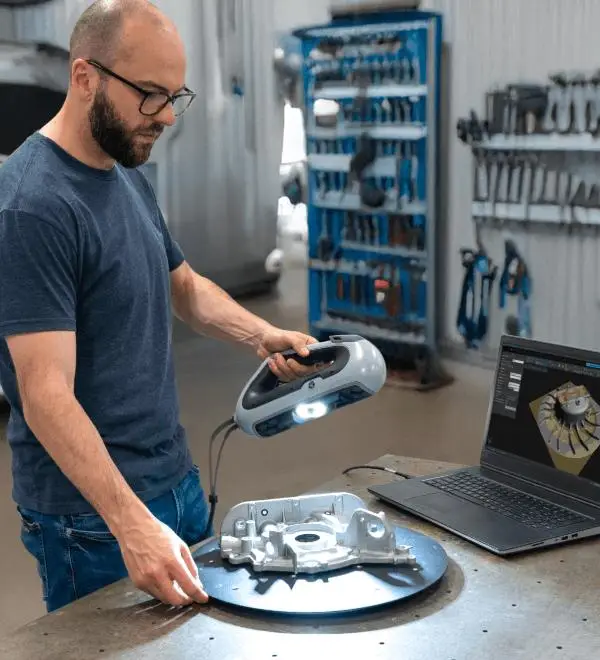
How 3D Scanning Actually Works
Every 3D scan follows roughly the same three stages, regardless of which technology captures the data.
- Data capture. The scanner records the object’s surface geometry, either by projecting a pattern of light, sweeping a laser across it, or triangulating positions from multiple photographs. This step produces raw point cloud data, sometimes millions of points per second.
- Processing into a usable model. Raw point cloud data isn’t directly usable. It gets aligned, cleaned of noise, and converted into a mesh (a surface made of connected triangles) or, for engineering work, into a parametric CAD model built on top of that mesh.
- Application of the data. Depending on the goal, the finished model either becomes a reference for reverse engineering, a comparison file for quality inspection, or a print-ready CAD file for reproduction.
The technology used at step one has the biggest impact on accuracy, speed, and cost, which is why choosing the right method matters more than most people realise going in.
The Main 3D Scanning Technologies Compared
Not every scanning method suits every object. A scanner built for capturing a small mechanical part isn’t the right tool for a large architectural model, and a technique that works well on a matte plastic component will struggle badly on polished chrome.
| Method | How It Works | Best For | Typical Accuracy | Limitations |
| Structured light scanning | Projects a light pattern onto the object; cameras measure the distortion | Small to medium parts, product design, engineering components | High (fractions of a millimetre) | Struggles with reflective or transparent surfaces |
| Laser triangulation scanning | A laser line sweeps the surface; sensors map distance at each point | Complex geometries, industrial parts, reverse engineering | High | Slower on very large objects |
| Photogrammetry | Multiple photographs from different angles are triangulated into a 3D mesh | Large objects, architecture, outdoor or on-site capture | Moderate | Less precise than laser or structured light |
| Industrial CT scanning | X-rays pass through the object to capture internal and external geometry | Internal structures, assemblies, hidden defects | Very high | Higher cost, specialised equipment |
| Contact-based scanning | A physical probe touches and records points on the surface | High-precision metrology, rigid parts | Extremely high at individual points | Slow, cannot capture soft or complex free-form surfaces |
For most manufacturing and reverse engineering work in the UAE, structured light and laser triangulation scanning cover the vast majority of projects. Photogrammetry earns its place for large-scale or architectural jobs where portability matters more than sub-millimetre precision.
What 3D Scanning Is Actually Used For
The applications sound broad because the technology genuinely is broad, but most projects fall into a handful of categories.
Reverse engineering. When a part’s original CAD files don’t exist, whether because the manufacturer is gone, the documentation was lost, or the component predates digital design entirely, scanning is the starting point for rebuilding it as a usable, manufacturable model.
Quality inspection. Manufactured parts get scanned and compared directly against the original CAD design. The result is typically a colour map showing exactly where the part deviates from spec, which is far faster and more objective than manual measurement.
Prototyping and product design. Designers scan physical mock-ups, sculpted models, or existing products to bring them into CAD software for refinement, rather than modelling complex organic shapes from scratch.
Automotive. Scanning captures worn, damaged, or discontinued components (trim panels, knobs, badges, engine parts) for exact digital reproduction, which is especially valuable for classic or out-of-production vehicles.
Architecture and construction. Scale models, structural mock-ups, and as-built documentation of existing spaces all rely on scanning to capture real-world dimensions accurately.
Custom and bespoke manufacturing. Anything that needs to fit a specific existing space, object, or person, from a replacement bracket to a fitted enclosure, starts with an accurate scan of what it needs to match.
3D Scanning vs Reverse Engineering: What’s the Difference?
These two terms get used almost interchangeably, but they aren’t the same thing, and understanding the distinction saves confusion when you’re briefing a project.
3D scanning is the data capture step. It produces a point cloud or mesh that represents the object’s surface. Reverse engineering is the broader process that follows: taking that scan data and reconstructing it into a clean, parametric, manufacturable CAD model, often correcting distortions, filling gaps, and rebuilding proper tolerances that a raw scan alone doesn’t have.
In practice, a raw scan is rarely production-ready on its own. It shows you what the object looks like, but it doesn’t have the engineering behind it, real dimensions, real tolerances, or features that can be edited or modified. That reconstruction work is where an experienced CAD team earns its value, and it’s the difference between a mesh that looks right on screen and a file you can actually manufacture from.
What Affects the Cost of 3D Scanning in the UAE
3D scanning pricing in Dubai and the wider UAE typically starts from around AED 300 for straightforward projects, though the final number depends on several factors that are worth understanding before you request a quote.
| Cost Factor | Lower Cost | Higher Cost |
| Part size | Small components (clips, knobs, brackets) | Large assemblies or structures |
| Geometry complexity | Simple, mostly flat surfaces | Undercuts, organic shapes, intricate detail |
| Surface material | Matte, opaque surfaces | Reflective, transparent, or chrome finishes |
| Deliverable needed | Raw mesh or point cloud | Fully reconstructed, parametric CAD model |
| Part condition | Clean, intact, accessible | Delicate, damaged, or requiring special handling |
| Location | Scan at the provider’s facility | On-site scanning requiring travel |
The single biggest driver of cost isn’t usually the scanning itself. It’s what happens afterward. A raw point cloud is relatively quick to capture, but converting that data into a fully toleranced, production-ready CAD file takes engineering time, and that’s where project cost genuinely varies.
How Robust 3D Approaches 3D Scanning
At Robust 3D Engineering Solutions in Dubai, scanning is treated as the first step of a manufacturing process, not a standalone deliverable. Our scanning equipment captures complex geometries and free-form surfaces to high precision- the level of detail that matters when a fraction of a millimetre decides whether a part fits or doesn’t.
From there, our engineers convert raw scan data into a clean, parametric CAD model rather than handing back an unedited mesh. That means the file has real dimensions, real tolerances, and real engineering behind it, ready for modification or direct manufacturing. Where it makes sense, we can also improve on the original design during reconstruction: correcting a known weak point, reducing unnecessary material, or adapting the geometry for 3D printing or CNC production. Once the CAD model is finalised, we can move straight into manufacturing using our in-house FDM, SLA, and SLS printing capabilities, so there’s no handoff gap between the scan and the finished part.
Choosing a 3D Scanning Partner: What to Check
Not all scanning providers deliver the same quality of output, and the difference often isn’t obvious until you’re holding a file that doesn’t quite work. A few things worth confirming before committing to a provider:
- Do they deliver a raw mesh or a reconstructed CAD model? These are very different deliverables, and the price difference should reflect that.
- What equipment do they use, and does it suit your part? A scanner optimised for small components isn’t the right choice for a large architectural piece, and vice versa.
- Can they handle your material? Reflective, transparent, or very dark surfaces need specific scanning approaches or surface preparation.
- Do they offer engineering support beyond the scan itself? If the end goal is manufacturing, a provider who can also design, optimise, and produce the part saves you from coordinating three separate vendors.
- What’s their turnaround time for your part’s complexity? Simple components can often be scanned and reconstructed within days; complex assemblies take longer, and a provider should be upfront about which category your project falls into.