Every successful product starts with an idea, but turning that idea into a functional, market-ready product takes careful planning, technical expertise, and the right development process. Whether you are creating a new consumer product, an industrial component, or a custom mechanical part, jumping straight into manufacturing without proper design and testing can lead to expensive mistakes, production delays, and poor product performance.
This is why product design and prototyping play such an important role in modern product development. They allow businesses to evaluate ideas, test functionality, improve designs, and resolve potential issues before investing in full-scale production.
Thanks to technologies such as CAD design, 3D scanning, reverse engineering, and rapid prototyping, businesses can now develop products faster than ever while reducing development costs and improving quality. Instead of relying on assumptions, teams can evaluate physical prototypes, gather feedback, and make informed improvements before final production begins.
In this guide, we explain the complete journey from product design to prototype, covering each stage of the process and highlighting why a structured development approach leads to better products and more efficient manufacturing.
Why Product Design and Prototyping Matter
Product development is rarely a one-step process. Even the simplest products often go through several revisions before they are ready for manufacturing. A well-planned design and prototyping process helps identify potential problems early, allowing businesses to refine their ideas before committing to production.
Creating a prototype allows engineers, designers, and stakeholders to see how a product performs in real-world conditions. It becomes easier to evaluate dimensions, ergonomics, assembly, strength, and functionality while avoiding costly manufacturing errors later.
Investing time in product design and prototyping also helps reduce material waste, shorten development timelines, and improve communication between design and manufacturing teams. As a result, businesses can launch products with greater confidence and fewer unexpected challenges.
Step 1: Define the Product Idea and Requirements
Every successful project begins with a clear understanding of the product’s purpose. Before creating sketches or CAD models, it is important to define exactly what the product is expected to achieve.
Start by identifying the problem the product will solve and who will use it. Consider the environment in which it will operate, its expected lifespan, load requirements, material preferences, and any applicable regulatory standards.
At this stage, it is also useful to establish project goals, production volumes, budget expectations, and target timelines. These factors influence design decisions throughout the development process.
A clear project brief helps prevent unnecessary revisions and provides a solid foundation for the engineering team.
Step 2: Create Initial Concepts and CAD Designs
Once the project requirements are defined, designers begin developing initial concepts. These concepts may start as hand sketches before being converted into detailed three-dimensional CAD models.
CAD modelling is one of the most important stages of product development because it transforms ideas into precise digital designs. Engineers can accurately define dimensions, tolerances, assemblies, and moving parts while ensuring that every component fits together correctly.
During this stage, multiple design options are often explored. Small adjustments to wall thickness, internal structures, mounting points, or material usage can significantly improve product performance while reducing manufacturing costs.
Good product design is not only about appearance. It also considers manufacturability, durability, ease of assembly, maintenance requirements, and overall functionality.
Collaboration between designers and engineers during this phase helps produce a design that performs well while remaining practical to manufacture.
Step 3: Select the Right Materials and Manufacturing Method
Material selection directly affects the strength, durability, weight, and appearance of the final product. Choosing the wrong material can result in poor performance, unnecessary costs, or manufacturing difficulties.
The selection depends on several factors, including the product’s intended use, environmental conditions, mechanical loads, and surface finish requirements.
For example, lightweight plastic materials may be suitable for concept models, while engineering-grade materials are often required for functional testing or industrial applications.
At the same time, the appropriate manufacturing method must be selected. Different 3D printing technologies offer different advantages depending on the project requirements. Some provide excellent surface quality for presentation models, while others deliver greater strength for functional prototypes or mechanical components.
Working with experienced engineering professionals helps ensure that both the material and manufacturing process align with the product’s intended application.
Step 4: Build the First Prototype
Once the design and materials have been finalised, the first physical prototype can be produced.
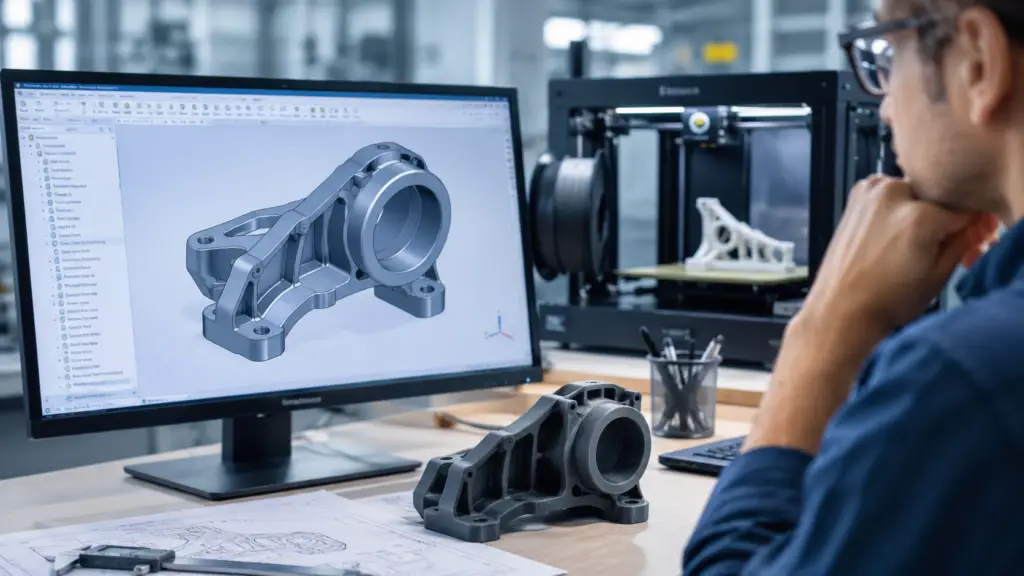
This stage allows the digital design to become a tangible product that can be inspected, assembled, and tested. Holding a physical model often reveals opportunities for improvement that may not be obvious when viewing a design on a computer screen.
Depending on the project, prototypes may serve different purposes.
A visual prototype focuses on appearance, dimensions, and presentation.
A functional prototype is designed to evaluate mechanical performance, fit, strength, and usability.
Some projects require multiple prototypes, each developed to validate different aspects of the design before production begins.
Rapid prototyping significantly reduces the time required to produce these models, allowing businesses to move quickly through the design cycle and reach manufacturing sooner.
Step 5: Test, Evaluate and Improve the Design
Very few products are perfect after the first prototype. Testing is an essential part of the development process because it provides valuable information about how the product performs under real operating conditions.
Engineers evaluate factors such as structural strength, dimensional accuracy, ease of assembly, user experience, and overall functionality. Any weaknesses identified during testing are documented and addressed through design improvements.
Feedback from customers, stakeholders, or technical teams may also lead to design refinements. Sometimes these changes are minor, while other projects require several iterations before the desired performance is achieved.
Although multiple revisions may seem time-consuming, they often prevent much higher costs that could arise after production has started.
The ability to quickly modify CAD files and produce updated prototypes is one of the biggest advantages of modern product development.
Step 6: Finalise the Design for Production
Once the prototype successfully meets all functional and quality requirements, the design can be prepared for manufacturing.
This involves reviewing final dimensions, confirming material specifications, validating tolerances, and ensuring that every component is ready for production.
At this stage, engineers also optimise the design for manufacturing efficiency. Small adjustments may reduce production costs, simplify assembly, or improve long-term product reliability without affecting performance.
A thorough quality review before production helps minimise manufacturing issues and supports consistent product quality across every production batch.
Preparing a design correctly before manufacturing saves both time and resources while reducing the likelihood of costly modifications later.
Common Challenges During Product Development
Product development often involves technical and commercial challenges that require careful planning and engineering expertise.
One common issue is incomplete design requirements. Without clearly defined objectives, projects can experience repeated revisions that increase both costs and development time.
Material selection is another frequent challenge. A material that performs well for visual prototypes may not provide sufficient strength for functional testing or end-use applications.
Manufacturing limitations must also be considered early in the design process. Complex geometries, tight tolerances, or unsuitable design features may require modifications before production becomes practical.
Budget constraints and aggressive timelines can further complicate development. Working with an experienced engineering partner helps balance performance, cost, and manufacturability while keeping the project on schedule.
How Professional Product Design and Prototyping Services Add Value
Professional engineering support extends far beyond producing CAD models or printing prototypes.
Experienced product development teams understand how design decisions influence manufacturing, material performance, assembly, and long-term product reliability. Their expertise helps identify potential issues before they become expensive production problems.
Access to advanced CAD software, industrial-grade 3D printing technologies, reverse engineering capabilities, and precision 3D scanning allows businesses to complete projects more efficiently while maintaining high-quality standards.
Professional support also improves collaboration between design, engineering, and manufacturing teams, helping businesses move from concept to production with fewer delays and greater confidence.
For companies developing new products, investing in professional design and prototyping services often results in shorter development cycles, reduced risks, and better-performing products.
Why Choose Robust3D for Product Design and Prototyping?
Developing a successful product requires more than a 3D printer. It requires engineering knowledge, practical manufacturing experience, and the ability to support every stage of the development process.
Robust3D provides end-to-end product development solutions that help businesses transform concepts into functional prototypes and production-ready designs. From CAD modelling and product design to rapid prototyping, reverse engineering, 3D scanning, and industrial 3D printing, every service is delivered with a focus on accuracy, quality, and efficiency.
By combining engineering expertise with advanced manufacturing technologies, Robust3D helps businesses reduce development time, improve product quality, and make informed decisions before production begins.
Whether you are developing a completely new product or improving an existing design, working with an experienced engineering partner can simplify the journey from concept to finished product.
Conclusion
A successful product is rarely created in a single attempt. It is the result of careful planning, thoughtful design, testing, and continuous improvement. Every stage, from defining the initial concept to producing and refining prototypes, plays an important role in creating products that perform reliably and are ready for manufacturing.
Businesses that invest in a structured product development process are better equipped to reduce risks, control costs, and accelerate time to market. By combining product design, CAD modelling, rapid prototyping, and engineering expertise, it becomes possible to identify challenges early and develop solutions with confidence.
If you are planning to bring a new product to market or improve an existing design, partnering with an experienced team like Robust3D can help turn your ideas into practical, high-quality products that are ready for the next stage of manufacturing.